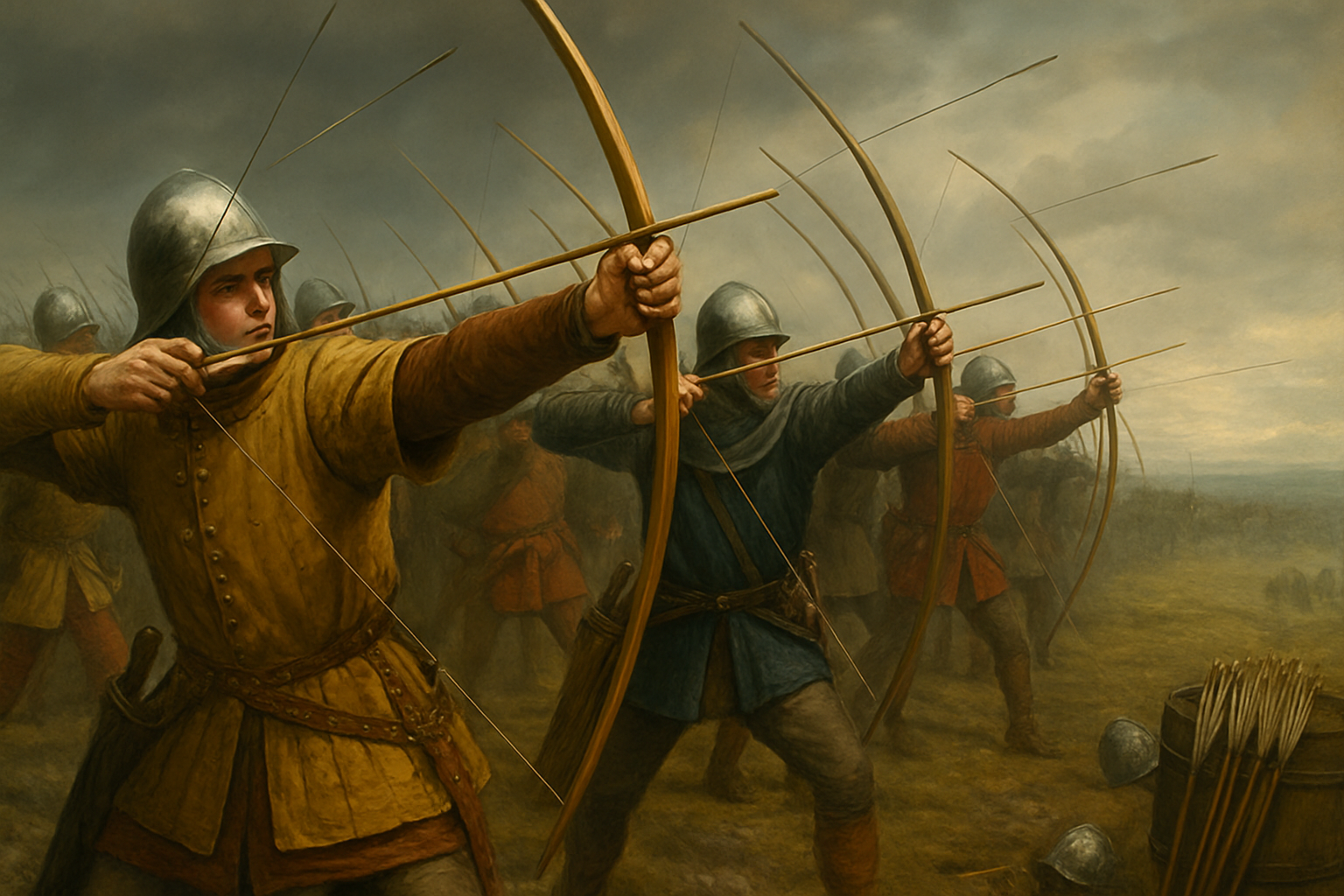
At Agincourt, English longbowmen unleashed thousands of arrows from over 250 yards away—striking faster, farther, and with such precision that they shattered cavalry before it could even close the distance.
Origins of the English Longbow
Evolving from Welsh designs in the 12th–13th centuries, the **English Longbow** gained royal backing under Edward I. Mandated archery practice created a nation of skilled bowmen—citizen-soldiers whose training made the weapon truly formidable.
Battles That Changed History
At **Crécy (1346)**, archers dismantled armored cavalry. **Poitiers (1356)** repeated the lesson against a larger force. At **Agincourt (1415)**, mud, narrow terrain, and relentless volleys multiplied the bow’s impact, breaking French lines and morale. In each case, technology + tactics beat size.
Why It Worked
Range, rate of fire, and discipline. A trained longbowman could loose 10–12 arrows per minute and hit effectively at long distances. The psychological effect of a “sky-darkening” volley mattered as much as penetration—*shock before contact*.
From Bows to Business: Force Multiplication
As Lee Peppers frames in Never Outmatched, **force multiplication** amplifies small inputs into outsized results. The longbow multiplied the power of ordinary soldiers; today, **AI multiplies the capability** of small teams—compressing time, expanding reach, and improving precision.
Modern Lessons for Teams Using AI
- Tool + Training: A bow without archers is useless; AI without onboarding is wasted. Invest in skills.
- Range Advantage: Data-driven targeting reaches further for less—your “long-range volley.”
- Tempo: Automations fire repeatedly—email, chat, ads—so you win on speed and consistency.
The Takeaway
The longbow didn’t win because it was shiny—it won because it was **integrated** into strategy and training. Do the same with AI: make it part of your daily motions and decision loops. That’s how underdogs become overdogs.